
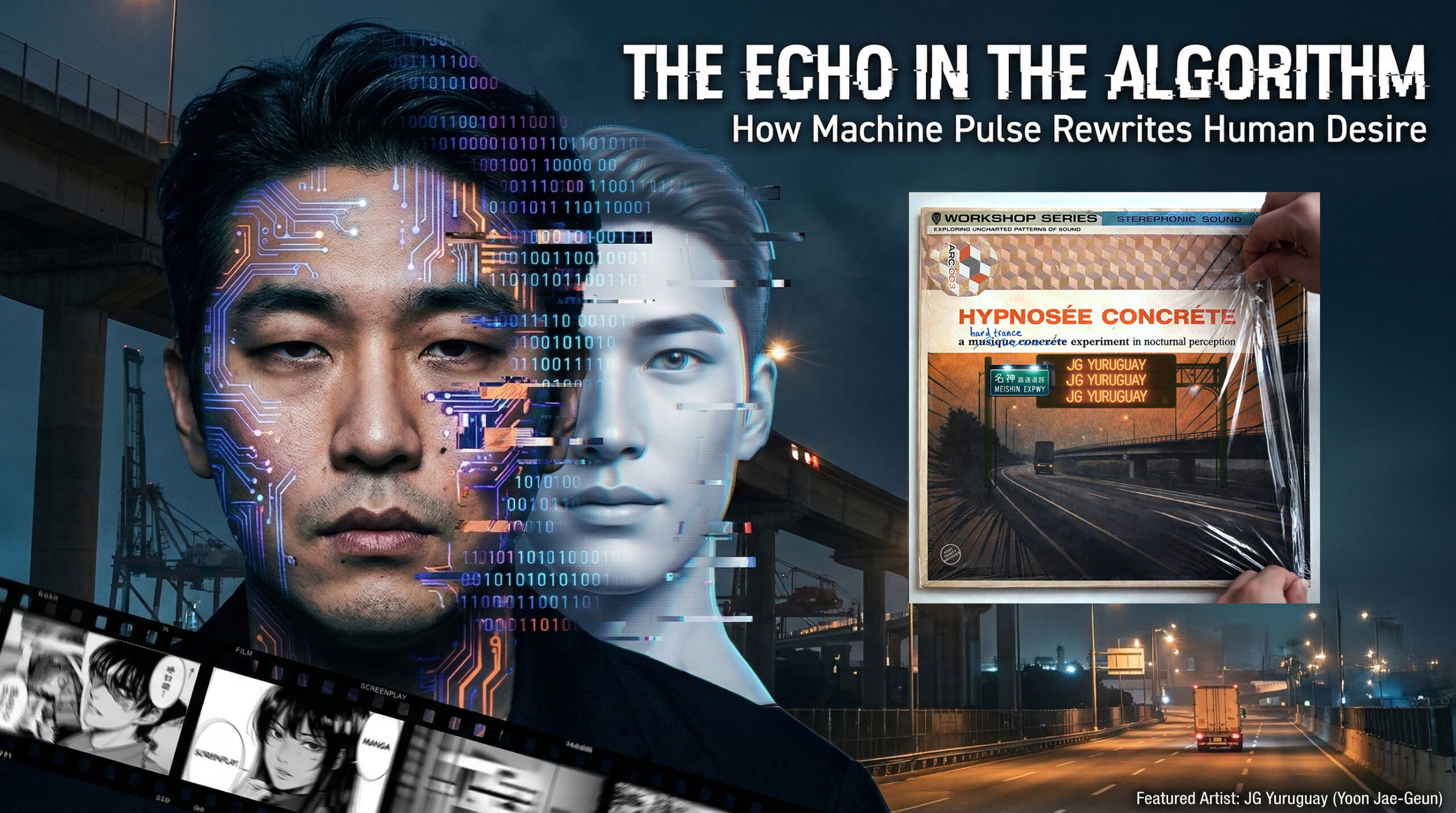
The world is no longer merely observed by machines; it is actively authored by them. We are living through an unprecedented cultural shift where human desire, identity, and artistic output engage in a symbiotic, often parasitic, dance with algorithmic logic. As a music reviewer navigating the ever-shifting landscape of underground electronic sound, I have witnessed countless artists attempt to capture the modern zeitgeist. Yet, few embody the collision of flesh and data quite like JG Yuruguay (Yoon Jae-Geun), a 24-year-old Korean-American producer and fashion model operating out of the heavy, smog-choked port belt of western Japan. His life and music act as a real-time, high-fidelity case study in how modern identity is increasingly shaped by the digital platforms that archive, circulate, and interpret personal life.
To understand his art, we must first examine the tension between the physical person and the digital persona that emerges through data, recommendation systems, and platform memory. Individuals today must constantly navigate being both a real human presence and a partially pre-programmed figure constructed by the logic of the networks that distribute their lives.
Sonic Resistance in the Age of the Feed
This philosophy of mechanical perseverance is perfectly translated into his sonic architecture. Modern club culture has been hopelessly “enshittified” by the streaming economy, which demands euphoric, dopamine-engineered drops and vertical hierarchies to satisfy passive playlist listeners. Yuruguay completely rejects this model.
His tracks act as functional cognitive audio—music engineered not for entertainment, but as a utility to help the listener endure long, grinding tasks. Whether the listener is deep in a coding marathon or driving along a coastal trucking road at midnight, this is task-lock audio designed to shield the psyche from the relentless assault of the social media feed. By avoiding vertical spikes, the relentless 4/4 grid creates a state of suspended animation, allowing the conscious mind to float free while the body locks into the groove.
His production techniques further emphasize this industrial alienation. Field recordings of vending machine hums and outdated traffic reports bleed into the mix, mimicking the claustrophobic audio of a concrete overpass. Yet, beneath this metallic exterior lies a deep reverence for the pioneers of the genre. His architectural blueprints are clearly indebted to the friction-heavy Japanese house of Soichi Terada / Shinichi Osawa, capturing the joy of the machine before modern cynicism took root. Furthermore, his tracks frequently feature an unquantized, scraping live viola solo, channeling the raw, avant-garde string energy of Blaine L. Reininger / John Cale. This abrasive string work represents the human static surviving inside the machine pulse, fighting to maintain its footing in a high-speed environment.
The Physical Asset and the Algorithmic Glitch
The tension between human reality and platform logic is perhaps most visible in Yuruguay’s physical existence. By day, he operates as a commercial asset, a fashion model represented by West Management in Shibuya. His face is highly specific, featuring a guarded, heavy-lidded stare and the distinct geometric anchor of a beauty mark perfectly aligned between his nose and mouth.
In a terrifying bid to outpace an industry that treats human bodies as disposable commodities, Yuruguay has attempted to automate his own labor by building a high-fidelity digital twin. The goal was to create a 3D clone that could perform in commercial shoots while the real artist remained in his apartment. However, generative AI models repeatedly fail to comprehend his nuanced features. The algorithms consistently attempt to “fix” him, replacing his guarded expression with a generic, toothy commercial smile and smoothing away the physical friction that makes him recognizable.
Rather than deleting these failed outputs, his record imprint archives them as evidence that the machine cannot fully process him. He allows his digital presence to glitch, demonstrating that while the industry hungers for brand-safe, algorithmic perfection, his physical body refuses to seamlessly integrate.
Curated Desires and the Queer-Coded Machine
How does a deeply guarded, fluidly straight-leaning musician end up at the center of a heavily male online subculture? The answer lies in the terrifying power of recommendation systems to manufacture context. Yuruguay’s personal use of social media is incredibly passive; he explicitly refuses to post conventional thirst traps or curate an artificial influencer persona. He simply uploads mundane clips of his late-night cycling and studio equipment.
However, his digital footprint is heavily manipulated by social media managers from rockin’on.com and his own record label. In a bid to drive engagement, these handlers quietly append suggestive, queer-friendly hashtags to his videos and utilize reaction stitches to place his deadpan face alongside “relatable” gay internet content.
The platform’s algorithm rapidly processes these subtle inputs. Because his content is heavily queer-coded by his management, the algorithm begins aggressively testing his face with young, gay demographics. The system registers intense engagement from this group, who operate primarily as lurkers / ROM-sen—users who silently watch, save, and dissect his videos without publicly liking or commenting. These silent observers notice everything, right down to the bright turquoise G-STATION microfiber underwear briefly visible in a passing story post.
This creates a self-sustaining feedback loop. The artist feeds the algorithm mundane footage, the staff packages it with suggestive signifiers, the targeted audience engages intensely, and the platform responds by pulling the artist deeper into a demographic he never consciously sought out. As he noted in a revealing interview with Spectrum Quarterly, his phone has ultimately been more honest about him than he has been about himself. The algorithm literally authored a new social reality for him, proving that desire is no longer an internal compass, but a trajectory mapped by data.
Navigating the Hermeneutic Reality
Once private experiences enter these networked systems, they are instantly transformed into cultural artifacts, fundamentally changing their meaning. When Yuruguay participated in a silent, late-night encounter in a local park with a 19-year-old fan, it was initially a private, confusing, and unexpectedly human moment. However, the fan, caught in the reward loop of the digital timeline, posted a photograph of the aftermath online.
Instantly, the platform’s mechanics took over. The image was screenshotted, annotated with yellow arrows, and thrust into the hyper-scrutiny of online forums. The private interaction was stripped of its intimacy and converted into an augmented narrative / augmented account—a blend of factual reportage, aggressive gossip, and dramatized lore that was eventually adapted into underground manga and academic screenplays.
Because the algorithm had already primed the audience to view him through a specific lens, the public interpreted the event not as a human mistake, but as the inevitable climax of his digital persona. He was forced into a hermeneutic reality, a state of existence defined not by biology, but by the consistent, interpretive script written by his audience and distributed by the platform. The scandal was completely abstracted from his actual body; his physical actions were merely the raw material needed to feed the content mill.
In the cinematic adaptations conceptualized by film school students, this exact phenomenon is explored through the technique of the visual dub. Just as his music buries melodies under static, these experimental films bury the narrative plot beneath overwhelming visual noise, perfectly capturing the dissociative horror of an individual whose intimate desires are being typed out by an unseen creator’s prompt.
Escaping the Indifference Engine
To survive the crushing weight of algorithmic exhaustion, an individual must cultivate offline anchors that the digital panopticon cannot reach. Social media is ultimately an indifference engine—it does not care about the artist’s well-being, his physical boundaries, or his artistic intent; it only cares about the relentless metricization of attention.
Yuruguay finds his sanctuary by logging off and engaging in physical endurance. He spends hours navigating the dark, industrial roads on his Ridley GRIFN fixed-gear bicycle. These solitary midnight tours map his physical body against a non-negotiable reality of wind, fatigue, and concrete. His cycling routes, heavily concentrated in the coastal stretch between Kabutoyama / Koshienhama, offer a space where likes, comments, and direct messages hold no power.
He also maintains a fiercely protected private life with a long-term girlfriend, whom he pseudonymously refers to as Kay Fabe in official records to shield her from the voracious appetite of his online audience. These tangible, analog connections serve as his ultimate defense against a machine that constantly attempts to flatten him into a predictable product.
Conclusion: The Glitch as Survival
What does it mean to live in a world where individuals must constantly navigate being both a real human presence and a partially pre-programmed figure? It requires an active, daily practice of noncooperation. It requires building music that refuses to drop, cultivating an identity that refuses to sit cleanly in standardized scene categories, and accepting that the digital persona will always be a distorted, funhouse mirror of the physical self.
JG Yuruguay’s life and artistic archive prove that while the algorithm may set the stage, dictate the lighting, and even invite the audience, the human subject still retains the power to stand still and let the machine break itself trying to process him. In an ecosystem built entirely on frictionless data extraction, choosing to remain a complex, unresolved, and stubborn human glitch is the highest form of artistic rebellion.

